
EATON · CROUSE-HINDS SERIES · CEAG
Global Reference Guide on the Marking of Electrical Equipment for Use in Explosive Atmospheres
ATEX (EU) / IECEx / UKCA and NEC / CEC (North America): how to read Ex marking, zones, gas and dust groups, temperature classes, types of protection, IP and NEMA ratings – from the Eaton wall chart, presented by VTL TECH, Eaton Crouse-Hinds distributor in Vietnam.

Part 1 – Marking according to ATEX (EU) / IECEx / UKCA
Typical marking – explosive gas atmospheres
 CE / UKCA marking and number of the notified body (0158 = DEKRA EXAM GmbH; 8505 = DEKRA UK) – not for category 3Ex ⬡Explosion protection symbolIIEquipment group – hazardous areas other than mines susceptible to firedamp2Equipment category (category 2)GExplosive atmosphere: gas, vapour or mistExExplosion protection markingdbType of protection: flameproof enclosure, level “db”ebType of protection: increased safety, level “eb”IICEquipment group II, subgroup IIC (typical gas: hydrogen)T4Temperature class (max. surface temperature 135 °C)GbEquipment protection level EPL Gb – high protection level
Typical marking – explosive dust atmospheres
Example of classification of explosive gas atmospheres into zones (IEC/EN 60079-10-1)
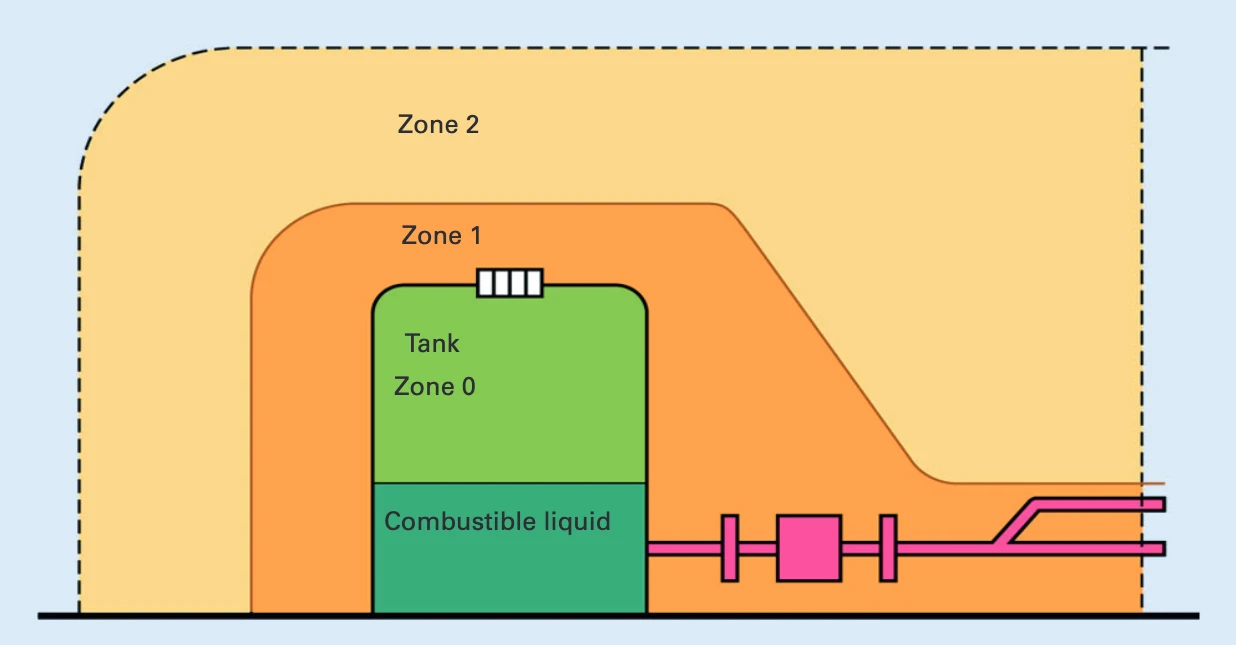
Zone 0 inside the tank; Zone 1 around openings; Zone 2 surrounding the area.
Example of classification of explosive dust atmospheres into zones (IEC/EN 60079-10-2)
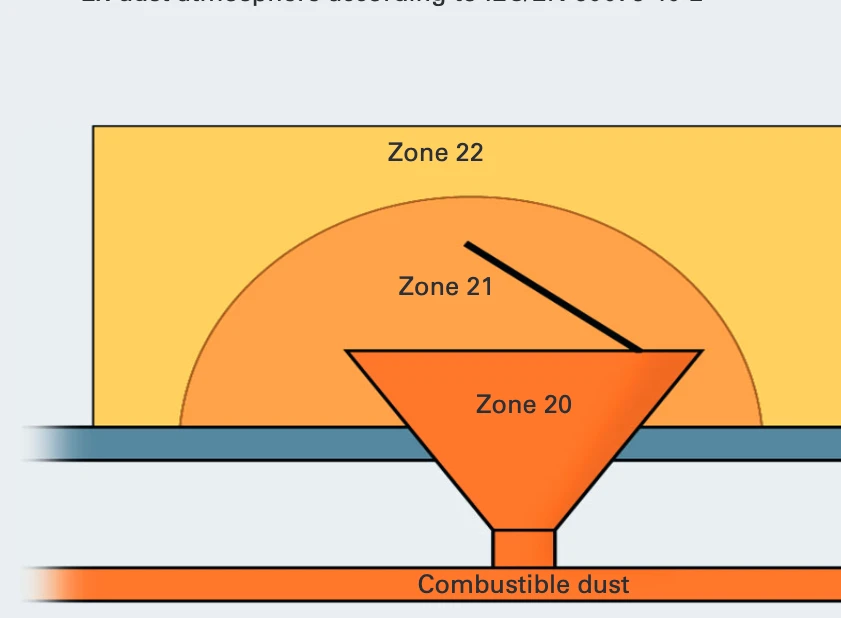
Zone 20 inside the hopper; Zone 21 around the filling opening; Zone 22 surrounding area.
Explosion group
| Explosive atmosphere | Typical combustible material | Group |
|---|---|---|
| Gas, vapour or mist | Acetylene | IIC |
| Hydrogen | IIC / IIB+H2 | |
| Ethylene/Formaldehyde | IIB | |
| Methane/Octane | IIA | |
| Dust – conductive | Metal dust, coal dust | IIIC |
| Dust – non-conductive | Grain dust | IIIB |
| Fibres & Flyings | Wood, paper or cotton processing | IIIA |
Temperature class
| Temperature class (IEC/EN 60079-0) | Maximum surface temperature |
|---|---|
| T1 | 450 °C |
| T2 | 300 °C |
| T3 | 200 °C |
| T4 | 135 °C |
| T5 | 100 °C |
| T6 | 85 °C |
IP degree of protection to IEC 60529
| First digit – solid foreign objects | Second digit – ingress of water | ||
|---|---|---|---|
| 0 | No protection | 0 | No protection |
| 1 | ≥ 50 mm diameter | 1 | Vertically dripping water |
| 2 | ≥ 12 mm diameter | 2 | 15° angled dripping water |
| 3 | ≥ 2.5 mm diameter | 3 | Spraying water |
| 4 | ≥ 1.0 mm diameter | 4 | Splashing water |
| 5 | Dust protected | 5 | Water jets |
| 6 | Dust tight | 6 | Strong water jets |
| 7 | Temporary submersion | ||
| 8 | Permanent submersion | ||
| 9 | High pressure, high temperature spray downs |
Electrical types of protection for explosive atmospheres due to flammable gases, vapours and mists
| Type | Protection level | Type of protection | Group | Equipment category | EPL | CENELEC / IEC standard | Protection concept |
|---|---|---|---|---|---|---|---|
| d | da | Flameproof enclosure | II | 1 G | Ga | EN/IEC 60079-1 | Explosion containment, prevention of flame transmission |
| d | db | Flameproof enclosure | II | 2 G | Gb | EN/IEC 60079-1 | Explosion containment, prevention of flame transmission |
| d | dc | Flameproof enclosure | II | 3 G | Gc | EN/IEC 60079-1 | Explosion containment, prevention of flame transmission |
| p | pxb, pyb | Pressurized enclosure | II | 2 G | Gb | EN/IEC 60079-2 | Exclusion of Ex-atmosphere |
| p | pzc | Pressurized enclosure | II | 3 G | Gc | EN/IEC 60079-2 | Exclusion of Ex-atmosphere |
| q | – | Powder filling | II | 2 G | Gb | EN/IEC 60079-5 | Prevention of explosion diffusion |
| o | ob | Liquid immersion | II | 2 G | Gb | EN/IEC 60079-6 | Exclusion of Ex-atmosphere |
| o | oc | Liquid immersion | II | 3 G | Gc | EN/IEC 60079-6 | Exclusion of Ex-atmosphere |
| e | eb | Increased safety | II | 2 G | Gb | EN/IEC 60079-7 | No arcs, sparks or hot surfaces |
| e | ec | Increased safety | II | 3 G | Gc | EN/IEC 60079-7 | No arcs, sparks or hot surfaces |
| i | ia | Intrinsic safety | II | 1 G | Ga | EN/IEC 60079-11 | Limitation of spark energy and surface temperature |
| i | ib | Intrinsic safety | II | 2 G | Gb | EN/IEC 60079-11 | Limitation of spark energy and surface temperature |
| i | ic | Intrinsic safety | II | 3 G | Gc | EN/IEC 60079-11 | Limitation of spark energy and surface temperature |
| p/v | – | Pressurized enclosure/ ventilation | II | 2 G | Gb | EN/IEC 60079-13 | Exclusion of Ex-atmosphere / dilution |
| nA | – | Non-sparking equipment | II | 3 G | Gc | EN/IEC 60079-15 | No arcs, sparks or hot surfaces |
| nC | – | Enclosed equipment | II | 3 G | Gc | EN/IEC 60079-15 | Explosion containment, prevention of flame transmission |
| nR | – | Restricted breathing enclosure | II | 3 G | Gc | EN/IEC 60079-15 | Exclusion of Ex-atmosphere for a limited period |
| m | ma | Encapsulation | II | 1 G | Ga | EN/IEC 60079-18 | Exclusion of Ex-atmosphere |
| m | mb | Encapsulation | II | 2 G | Gb | EN/IEC 60079-18 | Exclusion of Ex-atmosphere |
| m | mc | Encapsulation | II | 3 G | Gc | EN/IEC 60079-18 | Exclusion of Ex-atmosphere |
| i | – | Intrinsic system | II | 2 G | Gb | EN/IEC 60079-25 | Limitation of spark energy and surface temperature |
| – | – | Equipment with protection level (EPL) Ga | II | 1 G · 1 G/2 G | Ga · Ga/Gb | EN/IEC 60079-26 | Double protection concept |
| op is | – | Inherent safe optical radiation | II | 1 G | Ga | EN/IEC 60079-28 | Limitation of radiation energy |
| op is | – | Inherent safe optical radiation | II | 2 G | Gb | EN/IEC 60079-28 | Limitation of radiation energy |
| op is | – | Inherent safe optical radiation | II | 3 G | Gc | EN/IEC 60079-28 | Limitation of radiation energy |
| op pr · op sh | – | Safe/interlocked optical radiation | II | 2 G | Gb | EN/IEC 60079-28 | Limitation or containment of radiation energy |
| op pr · op sh | – | Safe/interlocked optical radiation | II | 3 G | Gc | EN/IEC 60079-28 | Limitation or containment of radiation energy |
| s | sa | Special protection | n.a. | n.a. | Ga | IEC 60079-33 | Special measures |
| s | sb | Special protection | n.a. | n.a. | Gb | IEC 60079-33 | Special measures |
| s | sc | Special protection | n.a. | n.a. | Gc | IEC 60079-33 | Special measures |
Electrical types of protection for explosive atmospheres due to combustible dust
| Type | Protection level | Type of protection | Group (Directive) | Group (Standard) | Equipment category | EPL | CENELEC / IEC standard | Protection concept |
|---|---|---|---|---|---|---|---|---|
| p | pxb | Pressurized enclosure | II | III | 2 D | Db | EN/IEC 60079-2 | Exclusion of Ex-atmosphere |
| p | pzc | Pressurized enclosure | II | III | 3 D | Dc | EN/IEC 60079-2 | Exclusion of Ex-atmosphere |
| i | ia | Intrinsic safety | II | III | 1 D | Da | EN/IEC 60079-11 | Limitation of spark energy and surface temperature |
| i | ib | Intrinsic safety | II | III | 2 D | Db | EN/IEC 60079-11 | Limitation of spark energy and surface temperature |
| i | ic | Intrinsic safety | II | III | 3 D | Dc | EN/IEC 60079-11 | Limitation of spark energy and surface temperature |
| m | ma | Encapsulation | II | III | 1 D | Da | EN/IEC 60079-18 | Exclusion of Ex-atmosphere |
| m | mb | Encapsulation | II | III | 2 D | Db | EN/IEC 60079-18 | Exclusion of Ex-atmosphere |
| m | mc | Encapsulation | II | III | 3 D | Dc | EN/IEC 60079-18 | Exclusion of Ex-atmosphere |
| op is | – | Inherent safe optical radiation | II | III | 1 D | Da | EN/IEC 60079-28 | Limit of radiation energy |
| op is | – | Inherent safe optical radiation | II | III | 2 D | Db | EN/IEC 60079-28 | Limit of radiation energy |
| op is | – | Inherent safe optical radiation | II | III | 3 D | Dc | EN/IEC 60079-28 | Limit of radiation energy |
| op pr · op sh | – | Safe/interlocked optical radiation | II | III | 2 D | Db | EN/IEC 60079-28 | Limitation or containment of radiation energy |
| op pr · op sh | – | Safe/interlocked optical radiation | II | III | 3 D | Dc | EN/IEC 60079-28 | Limitation or containment of radiation energy |
| t | ta | Protection by enclosure | II | III | 1 D | Da | EN/IEC 60079-31 | Exclusion of dust |
| t | tb | Protection by enclosure | II | III | 2 D | Db | EN/IEC 60079-31 | Exclusion of dust |
| t | tc | Protection by enclosure | II | III | 3 D | Dc | EN/IEC 60079-31 | Exclusion of dust |
| s | sa | Special protection | – | III | n.a. | Da | IEC 60079-33 | Special measures |
| s | sb | Special protection | – | III | n.a. | Db | IEC 60079-33 | Special measures |
| s | sc | Special protection | – | III | n.a. | Dc | IEC 60079-33 | Special measures |
Zone classification / Equipment protection level
| Substance | Period of presence of the combustible substances | Zone | Equipment group (Directive 2014/34/EU) | Equipment category | Group (IEC/EN 60079-0) | EPL | Protection level |
|---|---|---|---|---|---|---|---|
| Gas, mist, vapour | Continuously for long periods or frequently | Zone 0 | II | 1 G | II | Ga | very high |
| Occasional occurrence | Zone 1 | II | 2 G | II | Gb | high | |
| Not likely, but if it occurs only rarely and for a short period | Zone 2 | II | 3 G | II | Gc | enhanced | |
| Dust | Continuously for long periods or frequently | Zone 20 | II | 1 D | III | Da | very high |
| Occasional occurrence | Zone 21 | II | 2 D | III | Db | high | |
| Not likely, but if it occurs only rarely and for a short period | Zone 22 | II | 3 D | III | Dc | enhanced | |
| Methane, coal dust | Mining | I | M1 | I | Ma | very high | |
| Mining | I | M2 | I | Mb | high |
Minimum requirements for equipment according to Directive 2014/34/EU and standard IEC/EN 60079-0.
Classification into equipment groups and categories (Directive 2014/34/EU)
Equipment Group I – mines endangered by firedamp: categories M1 and M2
Equipment Group II – all other hazardous areas: categories 1, 2 and 3
Example of type label: CEAG product
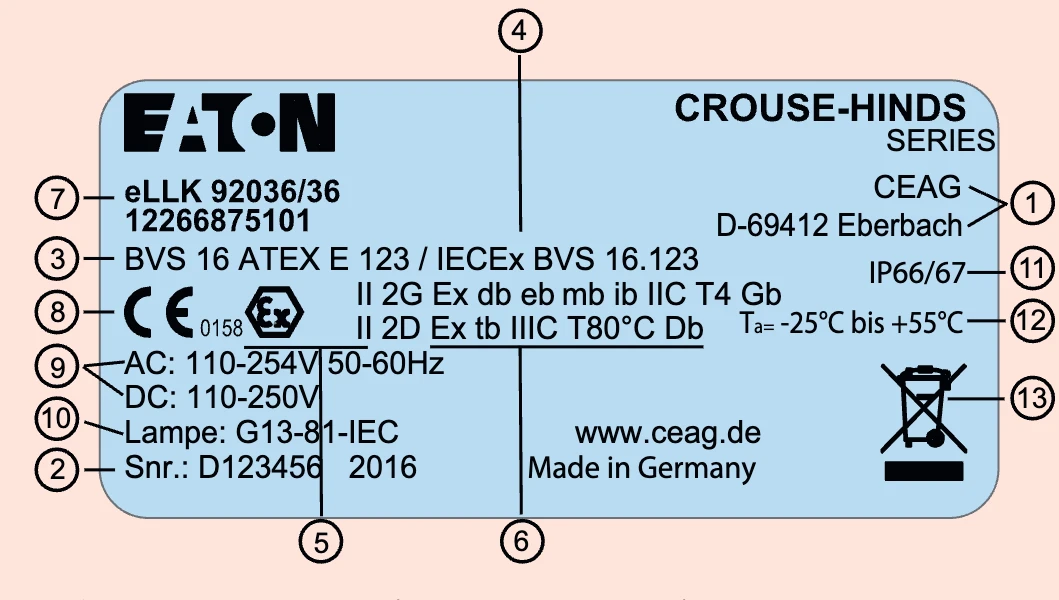
- Name or registered trade mark (CEAG) and address of the manufacturer
- Serial number including year of manufacture
- Certificate number, may end with “X” (special conditions for safe use apply) or “U” (component certificate)
- Additional IECEx certification
- Marking according to directive: equipment group (II), category (2), atmosphere G (gas, vapour or mist) – D (dust)
- Marking according to standard IEC/EN
- Equipment name/type
- CE marking and number of the notified body monitoring the quality system (0158 = EXAM Germany)
- Electrical parameters
- Other essential information (depends on the standard, e.g. lamp)
- Other optional information (e.g. degree of protection)
- Permissible ambient temperature (−25 °C to +55 °C); no marking required for −20 °C to +40 °C (standard values)
- Marking according to EU directive 2002/96/EC (WEEE)
Part 2 – NEC / CEC reference (USA and Canada)
Typical NEC/CEC Class/Division marking
Marking according to NEC 505-506 / CEC 18 (Zone)
Method of explosion protection
| Type of protection | Description | USA – NEC 500 Division | USA – NEC 505 Zone | Canada – CEC J18 Division | Canada – CEC 18 Zone | Protection concept |
|---|---|---|---|---|---|---|
| e | Increased safety | 2 | 1, 2 | – | 1, 2 | No arcs, sparks or hot surfaces |
| n | Non-incendive | 2 | 2 | 2 | 2 | |
| d | Flameproof | 2 | 1, 2 | – | 1, 2 | Contain the explosion prevent the flame propagation |
| – | Explosion-proof | 1, 2 | 1, 2 | 1, 2 | – | |
| q | Powder filled | 2 | 1, 2 | – | 1, 2 | |
| ia | Intrinsic safety | 1, 2 | 0, 1, 2 | 1, 2 | 0, 1, 2 | Limit the energy of the spark and the surface temperature |
| ib | Intrinsic safety | 2 | 1, 2 | – | 1, 2 | |
| p | Pressurized (purged) | 1, 2 | 1, 2 | 1, 2 | 1, 2 | Keep the flammable gas out |
| pxb | Pressurized (purged) | 1, 2 | 1, 2 | – | 1, 2 | |
| pyb | Pressurized (purged) | 1, 2 | 1, 2 | – | 1, 2 | |
| m | Encapsulation | 2 | 1, 2 | – | 1, 2 | |
| ma | Encapsulation | 1, 2 | 0, 1, 2 | – | 0, 1, 2 | |
| mb | Encapsulation | 2 | 1, 2 | – | 1, 2 | |
| o | Oil immersion | 2 | 1, 2 | 2 | 1, 2 |
Area classification
| Continuous hazard | Intermittent hazard | Hazard under abnormal conditions | |
|---|---|---|---|
| NEC 500-503 / CEC J18 | Division 1 | Division 1 | Division 2 |
| NEC 505-506 / CEC 18 | Zone 0 (Zone 20 dust) | Zone 1 (Zone 21 dust) | Zone 2 (Zone 22 dust) |
Temperature classification according to NEC/CEC
| Maximum surface temperature | US Zone concept | US Division / Canada Zone and Division concept |
|---|---|---|
| 450 ºC (842 ºF) | T1 | T1 |
| 300 ºC (572 ºF) | T2 | T2 |
| 280 ºC (536 ºF) | T2A | |
| 260 ºC (500 ºF) | T2B | |
| 230 ºC (446 ºF) | T2C | |
| 215 ºC (419 ºF) | T2D | |
| 200 ºC (392 ºF) | T3 | T3 |
| 180 ºC (356 ºF) | T3A | |
| 165 ºC (329 ºF) | T3B | |
| 160 ºC (320 ºF) | T3C | |
| 135 ºC (275 ºF) | T4 | T4 |
| 120 ºC (248 ºF) | T4A | |
| 100 ºC (212 ºF) | T5 | T5 |
| 85 ºC (185 ºF) | T6 | T6 |
Hazardous atmosphere category (gas or dust grouping)
| Explosive atmosphere | Typical hazard material | Hazard category (NEC 500-503 / CEC J18) | Grouping | Gas grouping (NEC 505 / CEC 18) |
|---|---|---|---|---|
| Gases and vapours* | Acetylene | Class I | Group A | IIC |
| Hydrogen | Class I | Group B | IIC / IIB+H2 | |
| Ethylene/Formaldehyde | Class I | Group C | IIB | |
| Methane/Octane | Class I | Group D | IIA | |
| Dust** | Metal dust | Class II | Group E | IIIC |
| Coal dust | Class II | Group F | IIIC | |
| Grain dust | Class II | Group G | IIIB | |
| Fibres & Flyings | Wood, paper or cotton processing | Class III | – | IIIA |
* Equipment listed and marked in accordance with 505.9(C)(2) for use in Zone 0, 1, or 2 locations is permitted in Class I, Division 2 locations for the same gas and with a suitable temperature class (NEC article 501.5); in Canada equipment suitable for Zone 0, 1 or 2 is permitted in Class I Division 2 locations with a suitable temperature class per CE Code Rule J18-150.
** Equipment listed and marked in accordance with 506.9(C)(2) for Zone 20, 21, or 22 locations is permitted in Class II, Division 2 locations for the same dust atmosphere and with a suitable temperature class. In Canada: (i) EPL Da, Db or Dc can be used in Class II, Division 2 locations per CEC Rule J18-274; (ii) EPL Da can be used in Class II Div 1 locations per CEC Rule J18-224. For Class III: EPL Da can be used in Division 1 and EPL Da, Db or Dc in Division 2, with a temperature class not greater than T120C (T165 °C for equipment that can be overloaded per CEC J18-326 / J18-376).
NEMA enclosure types
| Enclosure type | Intended use | Equivalent IP rating* |
|---|---|---|
| 1 | Indoor use, limited amounts of falling dirt | 20 |
| 3 | Outdoor use, rain, sleet, windblown dust, external formation of ice | 55 |
| 3R | Outdoor use, rain, sleet, external formation of ice | 24 |
| 3S | Outdoor use, rain, sleet, windblown dust, external mechanisms operable when ice laden | 55 |
| 4 | Indoor or outdoor use, windblown dust and rain, splashing water, hose directed water, external formation of ice | 66 |
| 4X | Indoor or outdoor use, windblown dust and rain, splashing water, hose directed water, corrosion resistant, external formation of ice laden | 66 |
| 5 | Indoor use, settling airborne dust, falling dirt, non-corrosive liquids | 53 |
| 6 | Indoor or outdoor use, hose directed water, temporary submersion, external formation of ice | 67 |
| 6P | Indoor or outdoor use, hose directed water, prolonged submersion, external formation of ice | 68 |
| 7** | Indoor use, Class I, Division 1, Groups A, B, C, and D hazardous locations, air-break equipment | – |
| 8** | Indoor or outdoor use, Class I, Division 1, Groups A, B, C, and D hazardous locations, oil-immersed equipment | – |
| 9** | Indoor use, Class II, Division 1, Groups E, F, and G hazardous locations, air-break equipment | – |
| 10** | Mining applications | – |
| 12 | Indoor use, circulating dust, falling dirt, dripping noncorrosive liquids | 54 |
| 12K | Indoor use, circulating dust, falling dirt, dripping noncorrosive liquids, provided with knockouts | 54 |
| 13 | Indoor use, lint, dust, spraying of water, oil and noncorrosive coolant | 54 |
* NEMA enclosure type can be converted to IP code rating, but IP codes cannot be converted to NEMA. ** Enclosure types for U.S. only (ref. NEMA 250).
Types of protection – flammable gases, vapours and mists (CSA/UL)
| Type | Protection level | Type of protection | EPL | CSA/UL standard | Protection concept |
|---|---|---|---|---|---|
| d | da | Flameproof enclosure | Ga | CAN/CSA C22.2 No. / UL No. 60079-1 | Explosion containment, prevention of flame transmission |
| d | db | Flameproof enclosure | Gb | CAN/CSA C22.2 No. / UL No. 60079-1 | Explosion containment, prevention of flame transmission |
| p | pxb, pyb | Pressurized enclosure | Gb | CAN/CSA C22.2 No. / UL No. 60079-2 | Exclusion of Ex-atmosphere |
| p | pzc | Pressurized enclosure | Gc | CAN/CSA C22.2 No. / UL No. 60079-2 | Exclusion of Ex-atmosphere |
| q | qb | Powder filling | Gb | CAN/CSA C22.2 No. / UL No. 60079-5 | Prevention of explosion diffusion |
| o | ob | Liquid immersion | Gb | CAN/CSA C22.2 No. / UL No. 60079-6 | Exclusion of Ex-atmosphere |
| e | eb | Increased safety | Gb | CAN/CSA C22.2 No. / UL No. 60079-7 | No arcs, sparks or hot surfaces |
| i | ia | Intrinsic safety | Ga | CAN/CSA C22.2 No. / UL No. 60079-11 | Limitation of spark energy and surface temperature |
| i | ib | Intrinsic safety | Gb | CAN/CSA C22.2 No. / UL No. 60079-11 | Limitation of spark energy and surface temperature |
| i | ic | Intrinsic safety | Gc | CAN/CSA C22.2 No. / UL No. 60079-11 | Limitation of spark energy and surface temperature |
| nA | – | Non-sparking equipment | Gc | CAN/CSA C22.2 No. / UL No. 60079-15 | No arcs, sparks or hot surfaces |
| nC | – | Enclosed equipment | Gc | CAN/CSA C22.2 No. / UL No. 60079-15 | Explosion containment, prevention of flame transmission |
| nR | – | Restricted breathing enclosure | Gc | CAN/CSA C22.2 No. / UL No. 60079-15 | Exclusion of Ex-atmosphere for a limited period |
| m | ma | Encapsulation | Ga | CAN/CSA C22.2 No. / UL No. 60079-18 | Exclusion of Ex-atmosphere |
| m | mb | Encapsulation | Gb | CAN/CSA C22.2 No. / UL No. 60079-18 | Exclusion of Ex-atmosphere |
| m | mc | Encapsulation | Gc | CAN/CSA C22.2 No. / UL No. 60079-18 | Exclusion of Ex-atmosphere |
| i | – | Intrinsic system | Gb | CAN/CSA C22.2 No. / UL No. 60079-25 | Limitation of spark energy and surface temperature |
Types of protection – combustible dust (CSA/UL)
| Type | Protection level | Type of protection | EPL | CSA/UL standard | Protection concept |
|---|---|---|---|---|---|
| p | pxb | Pressurized enclosure | Db | CAN/CSA C22.2 No. / UL No. 60079-2 | Exclusion of Ex-atmosphere |
| p | pzc | Pressurized enclosure | Dc | CAN/CSA C22.2 No. / UL No. 60079-2 | Exclusion of Ex-atmosphere |
| i | ia | Intrinsic safety | Da | CAN/CSA C22.2 No. / UL No. 60079-11 | Limitation of spark energy and surface temperature |
| i | ib | Intrinsic safety | Db | CAN/CSA C22.2 No. / UL No. 60079-11 | Limitation of spark energy and surface temperature |
| i | ic | Intrinsic safety | Dc | CAN/CSA C22.2 No. / UL No. 60079-11 | Limitation of spark energy and surface temperature |
| m | ma | Encapsulation | Da | CAN/CSA C22.2 No. / UL No. 60079-18 | Exclusion of Ex-atmosphere |
| m | mb | Encapsulation | Db | CAN/CSA C22.2 No. / UL No. 60079-18 | Exclusion of Ex-atmosphere |
| m | mc | Encapsulation | Dc | CAN/CSA C22.2 No. / UL No. 60079-18 | Exclusion of Ex-atmosphere |
| op is | – | Inherent safe optical radiation | Da | CAN/CSA C22.2 No. / UL No. 60079-28 | Limit of radiation energy |
| op is | – | Inherent safe optical radiation | Db | CAN/CSA C22.2 No. / UL No. 60079-28 | Limit of radiation energy |
| op is | – | Inherent safe optical radiation | Dc | CAN/CSA C22.2 No. / UL No. 60079-28 | Limit of radiation energy |
| op pr · op sh | – | Safe/interlocked optical radiation | Db | CAN/CSA C22.2 No. / UL No. 60079-28 | Limitation or containment of radiation energy |
| op pr · op sh | – | Safe/interlocked optical radiation | Dc | CAN/CSA C22.2 No. / UL No. 60079-28 | Limitation or containment of radiation energy |
| t | ta | Protection by enclosure | Da | CAN/CSA C22.2 No. / UL No. 60079-31 | Exclusion of dust |
| t | tb | Protection by enclosure | Db | CAN/CSA C22.2 No. / UL No. 60079-31 | Exclusion of dust |
| t | tc | Protection by enclosure | Dc | CAN/CSA C22.2 No. / UL No. 60079-31 | Exclusion of dust |
Committees and directives
NEMA – National Electrical Manufacturers Association. NEMA 250 series standards for enclosure types cover both hazardous and non-hazardous areas.
NEC – National Electrical Code (USA) · CEC – Canadian Electrical Code (Canada)
More on hazardous areas per NEC/CEC is in Eaton's Code Digest (NEC) and Hazardous Location Guide (CEC): Crouse-Hinds series training & technical info · 2020 Code Digest (NEC) · 2012 Hazardous Location Guide (CEC)
Eaton Crouse-Hinds distributor in Vietnam
Viet Thang Loi Technology Company Limited (VTL TECH)
19A Cong Hoa Street, Bay Hien Ward, Ho Chi Minh City
Tel: 028 3811 0510 / 11 · Fax: 028 3811 0512
Email: info@vtltech.com.vn · www.vtltech.com.vn
Advice on selecting CEAG / Crouse-Hinds explosion-protected equipment by zone, gas group and temperature class:
Eaton
Neuer Weg – Nord 49, D-69412 Eberbach
Tel +49 (0) 6271/806-500
E-mail info-ex@eaton.com · www.eaton.com